








Slitting PP、PS、PC and ABS Sheet for Carrier Tape: Material Challenges, Blade Selection, and Machine Requirements
Case Study 2026-06-03Carrier tape starts as a plain thermoplastic sheet. Before it becomes the embossed component packaging used in SMT production, it is slit into precise-width strips at a slitter rewinder. That slitting step is where the quality of the finished tape is decided — and where many problems start.
This guide covers the key challenges in slitting PC, ABS, and PS sheet for carrier tape production: what makes the edge condition critical, how different materials behave at the blade, and what the slitter needs to deliver to meet production standards. For the machine side of that question, our guide to how slitter rewinders are specified covers the main winding types, key components and slit-width ranges.
Why Carrier Tape Slitting Is More Demanding Than General Film Slitting
Most film slitting applications tolerate some degree of edge variation — the cut edge is trimmed, laminated, or printed before it reaches the end user. Carrier tape offers no such correction. The slit strip goes directly into the embossing press. Whatever edge condition the slitter produces is the condition the forming machine works with.
Strip widths for carrier tape run from 4 mm to 72 mm. At these narrow widths, small positional errors — a few tenths of a millimeter — affect pocket registration and feeder tracking on the assembly line.

What Burr Does to the Downstream Process
Burr on the slit edge creates three specific problems once the strip enters the embossing press:
Pocket contamination — burr fragments break off during forming and end up inside the component pocket, creating a foreign material risk.
Pocket geometry errors — edge deformation from burr causes the strip to track unevenly through the forming station. Pockets come out off-center or inconsistent in depth.
Line stops — in automatic embossing equipment, edge irregularities cause feed errors that stop the line.
Because of this, carrier tape producers check cut face quality under a microscope — not just at the start of the reel, but at the middle and end.

Material Differences: PC, PC+ABS, and Transparent PC at the Blade
The three main carrier tape sheet types behave differently at the slitter. The table below shows the key differences in slitting challenge, static sensitivity, and burr risk.
| Material | Conductive | Main slitting challenge | Static risk | Burr risk |
|---|---|---|---|---|
| PC+ABS+PC | Carbon Black Filled (Conductive / Antistatic) | Edge delamination between laminate layers | Low | Medium |
| PC+ABS+PS | Carbon Black Filled (Conductive / Antistatic) | PS layer prone to microcracking at cut face | Low | Medium–High |
| Transparent PC | Carbon Black Free; Non-Conductive | Carbon Black Free; No Static Dissipation Path; Dust Adheres to Knife Edge | High | High |
Transparent PC stands out because its failure mode is different from the others. It does not generate obvious burr early in the run. Instead, strong static charge causes fine cutting debris to accumulate on the blade edge progressively. The edge quality looks acceptable at the start of the reel, then deteriorates as the blade becomes coated with debris — often not visible until the middle or end of the reel.
This means a blade setup validated on PC+ABS blends may not hold on transparent PC, and vice versa. Each material type needs its own qualification run.
Blade Setup and Wear: What Matters for Carrier Tape
Engineering thermoplastics are harder than most film or label materials. Blade bevel angle — the geometry of the upper and lower knife edges — directly affects cut face quality. The right angle for clean edges on PC+ABS+PS is not necessarily the same as for transparent PC.
Blade durability under continuous production conditions is what separates a usable setup from a reliable one. A blade configuration that cuts cleanly at the start of a reel but generates burr by the 500-meter mark is not production-viable. Carrier tape slitter qualification should always include full-reel runs — no blade changes, with cut face documentation at reel start, midpoint, and end.
For transparent PC specifically: adjusting line speed or tension does not solve the debris buildup problem. The fix is static control at the slitting station — ionizing bars or anti-static guide systems — designed in as part of the machine configuration, not added afterward.
Machine Requirements for Carrier Tape Slitting
The table below lists the five machine requirements that carrier tape slitting demands, and what happens when each is not met.
| Requirement | Why it matters | What goes wrong without it |
|---|---|---|
| Stable tension, full reel length | Keeps the web steady at the blade | Slit width drifts; pockets go out of spec |
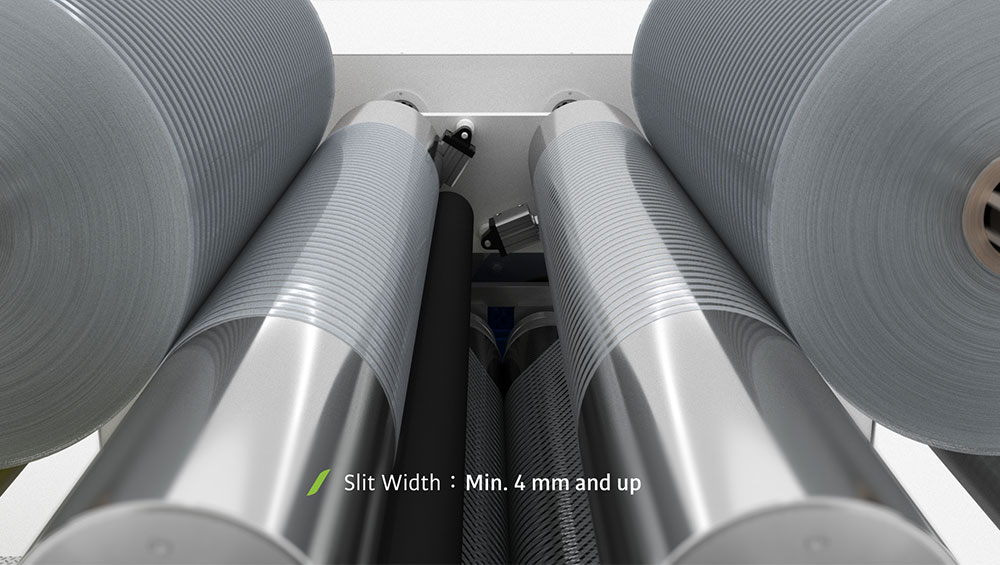
| Precise blade positioning | 40+ blades across the full web width, each requiring precise positioning. | Width error in outer lanes |
| Clean rewind end-face | Reel must unwind straight into the embossing press | Strip tracks sideways; line stops at embosser |
| Static control (transparent PC) | Prevents cutting debris from building up on the blade | Burr appears mid-reel, invisible at reel start |
| Fast format changeover | Multiple widths run on the same machine | Long changeover limits output per shift |
One point deserves emphasis: blade positioning precision is a mechanical design issue, not something an operator can compensate for. With 40 or more blade positions across a 600 mm parent roll, the cumulative tolerance of all the spacers determines whether the outermost lanes hold their target width. If the blade mounting system is not designed for this, the outer lanes will consistently run off-spec regardless of how carefully the machine is set up.


Recommended Machine: EG-300 Series Multi-Purpose Slitter Rewinder
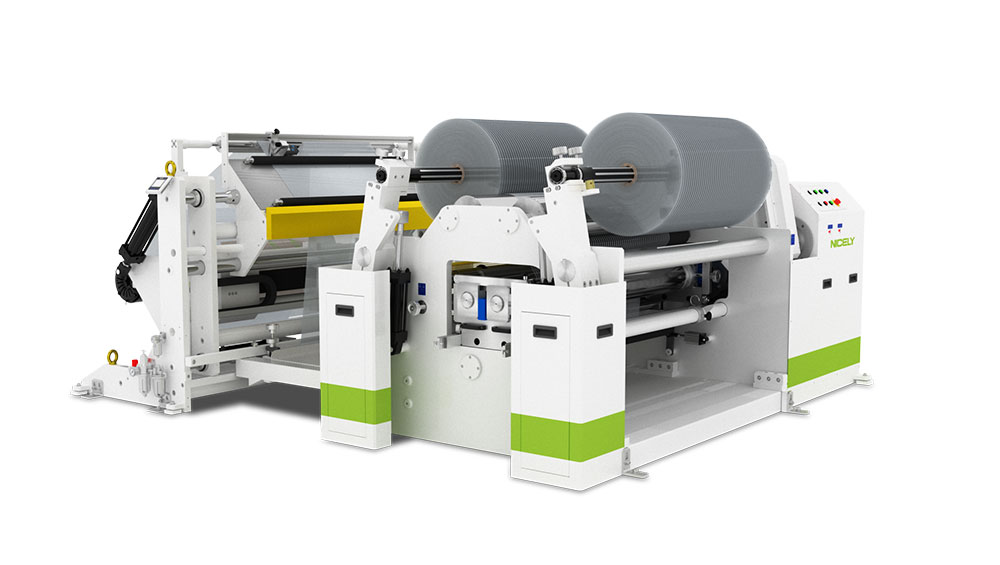
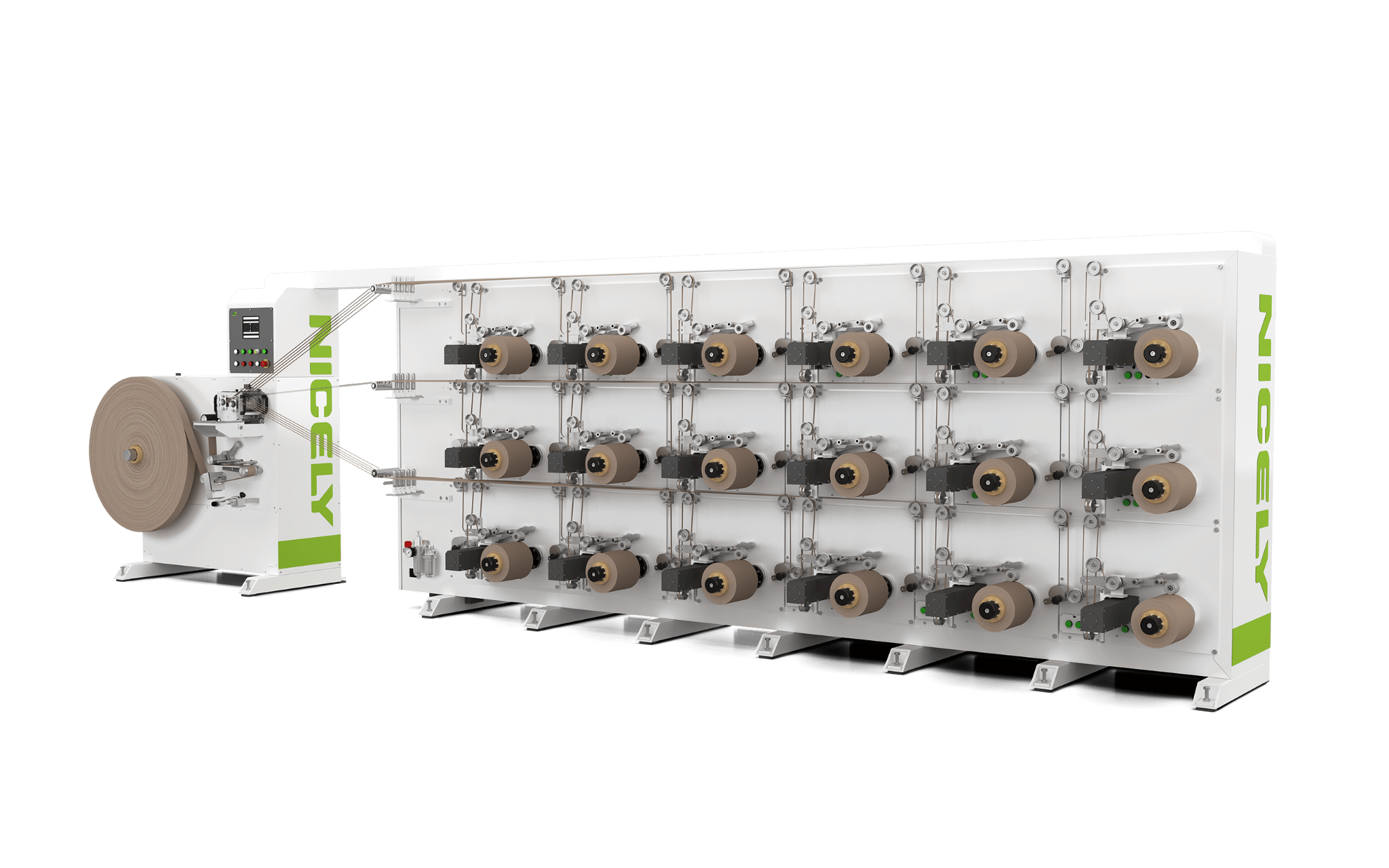
The EG-300 series is Nicely's multi-purpose slitter rewinder designed for a wide range of materials — including PP, PC, ABS, and PS engineering plastics engineering for carrier tape, cover tape, as well as copper foil, aluminum foil, mica tape, cover tape and carrier tape.
With both center winding and surface winding modes, a minimum slit width of 4 mm, and rewind diameters up to 800 mm, the EG-300 series directly addresses the narrow-width precision and multi-format changeover demands of carrier tape sheet slitting.
| Roller width | 600 – 1900 mm |
|---|---|
| Unwind diameter | 600 – 1200 mm |
| Min. slit width | 4 mm and up |
| Rewind diameter | 450 / 600 / 800 mm |
| Machine speed | 200 / 300 / 400 m/min |
Standard: Versatile slitting options; auto tension control; PLC with HMI touchscreen.
Optional: differential rewind shafts, cassette slitting unit, trim waste winder, and unloading system.
Full specifications:
https://nicely-slitter.com/en/product/All-purpose-Slitter-Rewinder.html
Choosing the Right Slitter for Carrier Tape Production
Carrier tape sheet slitting is a tighter-tolerance, harder-material application than most film or paper converting. The edge quality standard is enforced by the embossing equipment immediately downstream — there is no buffer.
Selecting the right slitter means matching the machine to the material: blade geometry for the specific sheet type, tension control that holds across a full reel, static management for transparent PC, and a rewind system that delivers consistent end-face quality run after run.
Contact Nicely's team to discuss your material and production requirements.